Service
AV & Audio DSP
AMX NetLinx / Muse programming, BSS DSP, JBL Professional, Dante audio networking; Bosch Praesideo, PAVIRO and TOA PA/VA.
Scope of work
- 01Site survey, room acoustic assessment and solution consulting
- 02Audio, video and control signal flow design
- 03Installation of microphones, loudspeakers, amplifiers, displays and conferencing cameras
- 04DSP programming and tuning: AEC, Automixer, EQ, Matrix routing
- 05Dante audio-over-IP and AV-over-IP configuration
- 06AMX central control programming (touch panels, power sequencing)
- 07BYOM (Bring Your Own Meeting) room design and deployment
- 08Bosch PA/VA public address and voice alarm integration
- 09Commissioning, sound tuning, operator training and documentation handover
Many buildings invest heavily in meeting rooms and conference halls but keep running into the same problems: echo, display failures, remote participants who cannot hear clearly. The cause is usually not poor equipment — it is equipment that has never been integrated into a system. Audio Visual (AV) and DSP audio processing are the two technical layers that determine whether that system actually works.
What is Audio Visual — and why does the standard definition fall short?
Most people understand "AV" as screens and speakers. For a systems integration engineer, Audio Visual is the entire technical chain from source to listener and viewer — how signals are processed, routed, transmitted, controlled and operated every day.
A proper AV system has three layers:
Audio layer: microphones capturing speech, a DSP processing and distributing the signal, amplifiers, loudspeakers. Each component has a distinct technical role and must work in sync.
Visual layer: cameras, video signal distribution (HDMI, HDBaseT, AV-over-IP), switching, displays, projectors or LED walls. Video signals today typically travel over IP networks rather than long HDMI cables.
Control layer: touch panels, keypads, management software. This is the interface between the end user and all the technical complexity behind it. A well-integrated AV system hides that complexity — the user sees only: power on, source select, volume.
When the three layers work as one, the result is: users walk into the room, plug in a laptop or tap the control panel and everything is ready. No technician. No setup time before every meeting.
Where AV systems are used: Video conferencing rooms (Teams, Zoom, Google Meet), conference halls, event spaces, lecture theatres, executive boardrooms, hotels, shopping centres and office buildings.
What is DSP — and why does it matter more than most people realise?
In an AV system, the visual side is usually what people notice — a good-looking screen, a sharp image. But it is the audio side that determines how well the system actually performs day to day. And within the audio side, the DSP is the deciding component.
A DSP (Digital Signal Processor) is the central processing unit of a professional audio system. Every signal — from microphones, computers, conferencing devices — passes through the DSP before reaching the loudspeakers. DSP is not just a "digital mixer" — what sets it apart are the signal-processing algorithms running inside.
AEC — Acoustic Echo Cancellation
The most common technical problem in video conferencing. When a room microphone picks up sound from the loudspeaker — the remote participant's voice — that participant hears their own voice echoed back with a delay. The DSP analyses a reference signal from the loudspeaker and subtracts it from the microphone signal before transmission. Teams and Zoom include single-channel AEC — adequate for a laptop. A meeting room with dedicated ceiling microphones needs DSP with independent AEC per channel.
Automixer — Only the active speaker's microphone opens
In a multi-person, multi-microphone room, keeping all microphones open means capturing chair scrapes, keyboard noise and air conditioning — and amplifying all of it. An automixer continuously analyses signal levels and opens only the microphone of the person speaking. The result: cleaner audio, less background noise, clearer sound for remote participants.
EQ and room-specific tuning
Every room has its own acoustic character — shape, wall materials, ceiling and floor all affect how sound reflects. Parametric EQ inside the DSP compensates: reducing frequencies that cause feedback, boosting the speech range for clarity, balancing coverage from each loudspeaker across the room.
Matrix routing — One signal to many destinations
A DSP can have 32 inputs and 32 outputs. A meeting room microphone can simultaneously feed the room loudspeakers, a conferencing platform, a recording system and an overflow room — all routed in software, with no additional physical cabling.
When is DSP essential?
Teams and Zoom include single-channel AEC — adequate for a laptop in a small room. When a room has dedicated ceiling microphones, independent loudspeakers and multiple users, DSP with per-channel AEC is required. Without it: feedback, echo and remote participants who cannot follow the conversation.
Dante — Audio over the network instead of analog cable
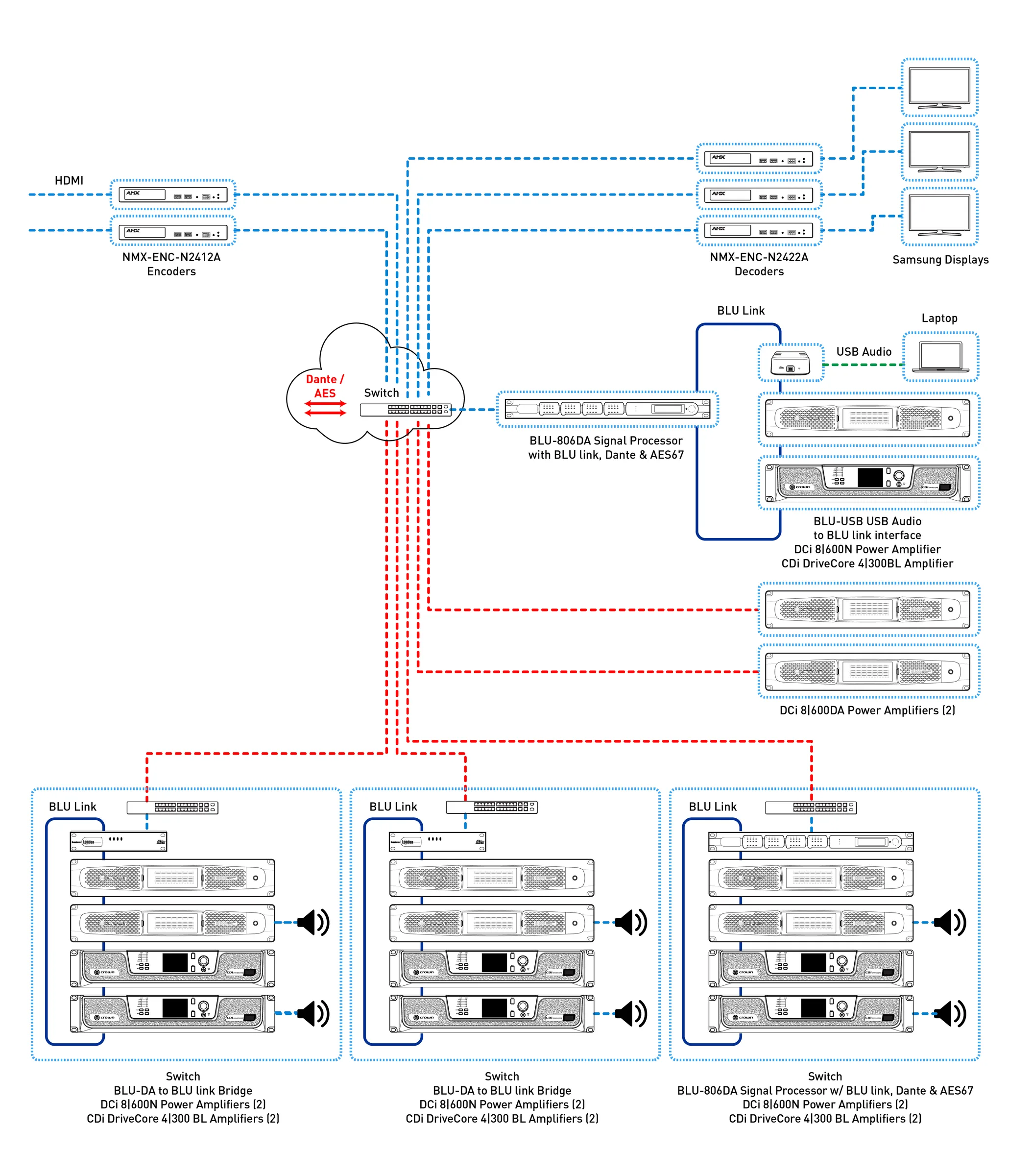
Dante is a digital audio-over-IP protocol developed by Audinate. Instead of running analog cable from microphones to the DSP and from the DSP to amplifiers, every Dante device connects to a network switch — the same infrastructure as computers and IP cameras.
64 channels of audio on a single network cable. A ceiling microphone at the far end of a building connects back to a central DSP with no dedicated analog cable run. The system scales by adding network switches, not cable.
AMX control programming — A system that knows what the user needs
AMX (HARMAN Professional) is one of the leading AV control platforms. Programming AMX NetLinx (NX series) and Muse creates a simple interface for a technically complex system.
A single AMX touch panel on the wall can control: powering the entire AV system in the correct sequence, source switching, DSP volume, conference lighting, blinds and dial-in conferencing — from one interface. The programming logic handles real-world scenarios: power failure, unresponsive devices, user error. The system must be stable enough to run without a technician in the room.
BYOM meeting rooms — The new standard for modern workspaces
BYOM (Bring Your Own Meeting) lets users walk in, connect a single USB-C cable and immediately have screen output, DSP-processed audio, a conferencing camera and a connection to Teams, Zoom or Google Meet. No software installation, no setup, no technician.
Proper BYOM design requires the right AV-over-IP hardware (such as the BSS OMNI 600 series with USB-C 4K60), DSP AEC configured for the room microphones and a network infrastructure with sufficient bandwidth for high-quality video conferencing.
Brands: BSS Audio · AMX · JBL Professional · Crown · Bosch · Dante (Audinate) · Harman Professional
