Audio & DSP· 11 November 2026· 5 min read
Dante Audio Network: The Standard Digital Audio Solution for Integration Engineers
Discover why Dante has become the benchmark technology, replacing traditional analog systems in modern professional audio projects.
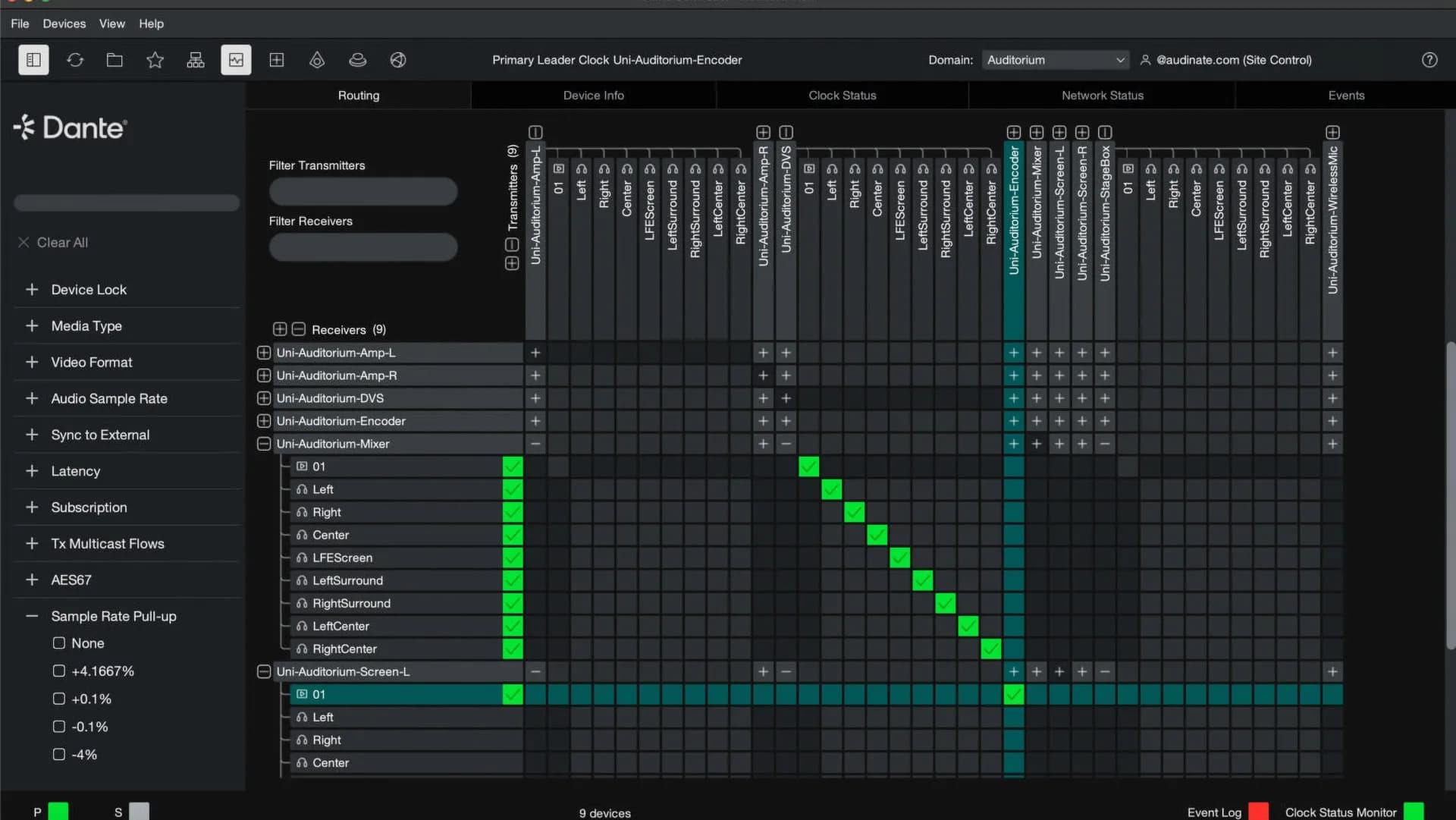
In recent years, the digital revolution has completely transformed how we design and operate audio systems. Gone are the days when large-scale stages or building systems required kilometers of bulky copper cabling. Today, the Dante (Digital Audio Network Through Ethernet) protocol has made everything more compact and intelligent by leveraging standard IP network infrastructure.
What is Dante and Why Does It Matter?
Dante, developed by Audinate, is a protocol for transmitting uncompressed, multi-channel digital audio over standard Ethernet networks. Instead of each audio channel requiring a physical wire like in analog systems, Dante encapsulates hundreds of audio channels into IP data packets and transmits them via Cat5e or Cat6 network cables.
For a systems integration engineer, Dante is more than just a transmission technology; it is a robust ecosystem. With interoperability across thousands of devices from brands like BSS, Crown, Yamaha, and Soundcraft, Dante has become the "universal language" of the professional AV industry.
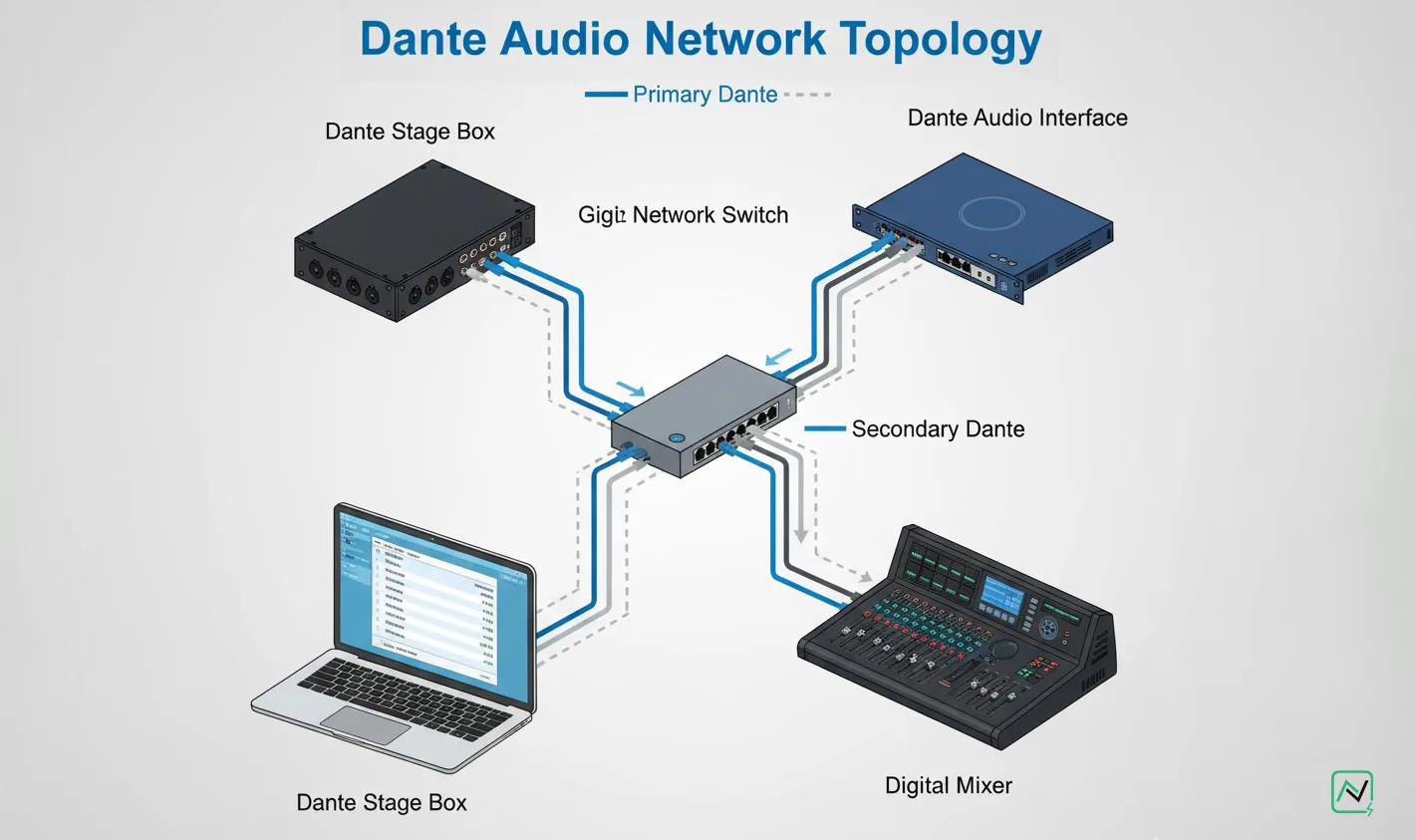
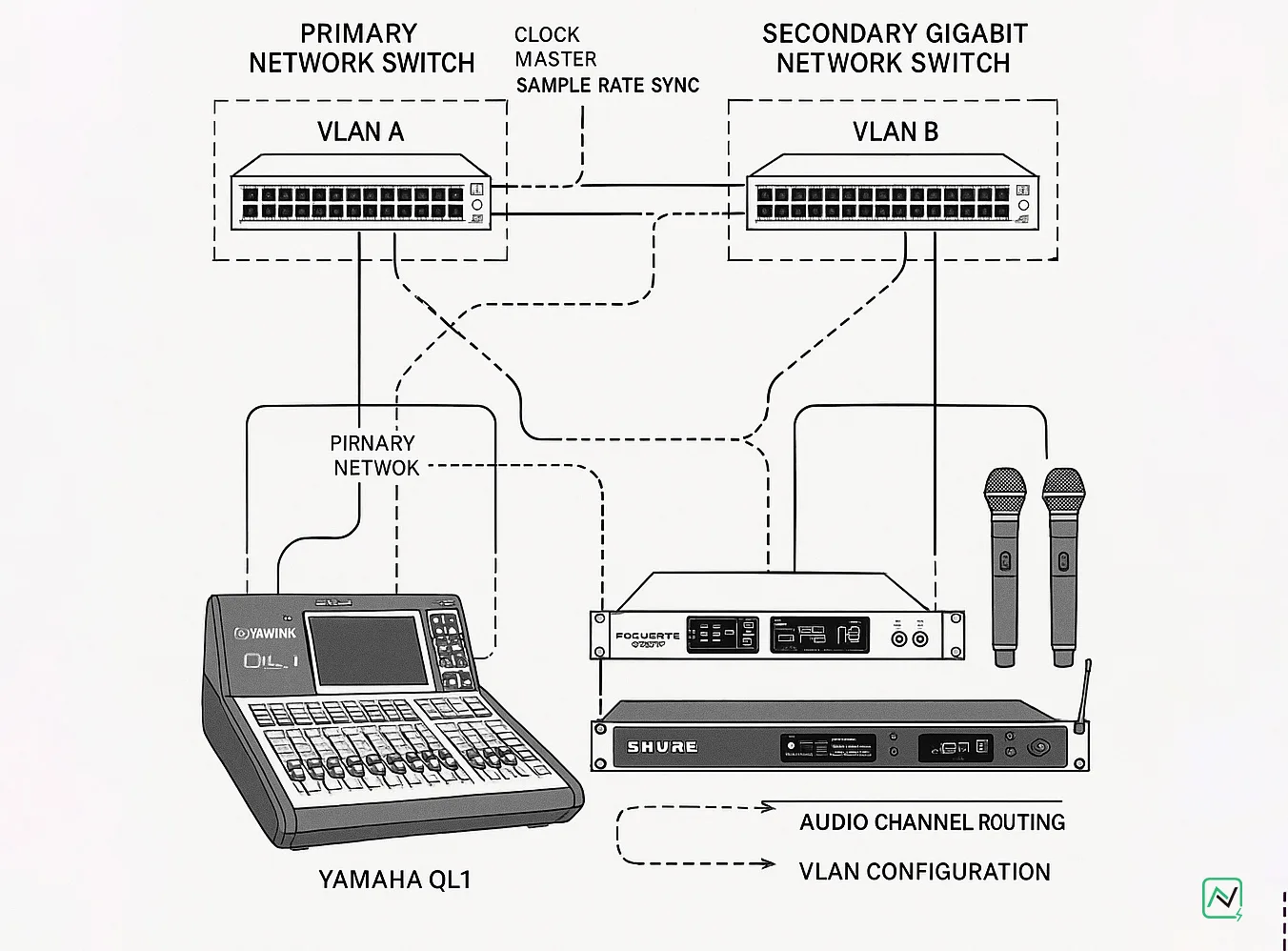
A typical model of device connectivity within a Dante network. Image: nguyenthiet.com
Why Choose Dante Over Analog?
A question I often receive from clients is: "Why invest in Dante equipment when the initial cost seems higher than analog?" The answer lies in operational efficiency and long-term scalability:
Reduced Cabling and Installation Costs: Instead of heavy analog snake cables, a single network cable can carry hundreds of channels. This significantly reduces material costs and labor time for cable pulling.
Flexible Routing: In an analog system, changing signal paths requires physical intervention at patch bays. With Dante, everything is handled via the Dante Controller software. You can route audio from a stage microphone to the FOH mixer, monitors, and recording setup with just a few clicks.
Perfect Audio Quality: As an uncompressed digital signal, audio transmitted via Dante does not suffer from signal loss, electromagnetic interference (EMI), or ground loops common in analog, even over distances of 100m (or much further via fiber optics).
Ultra-Low Latency: Dante provides deterministic and ultra-low latency (typically 0.25ms to 1ms), ensuring absolute synchronization for live performance applications.
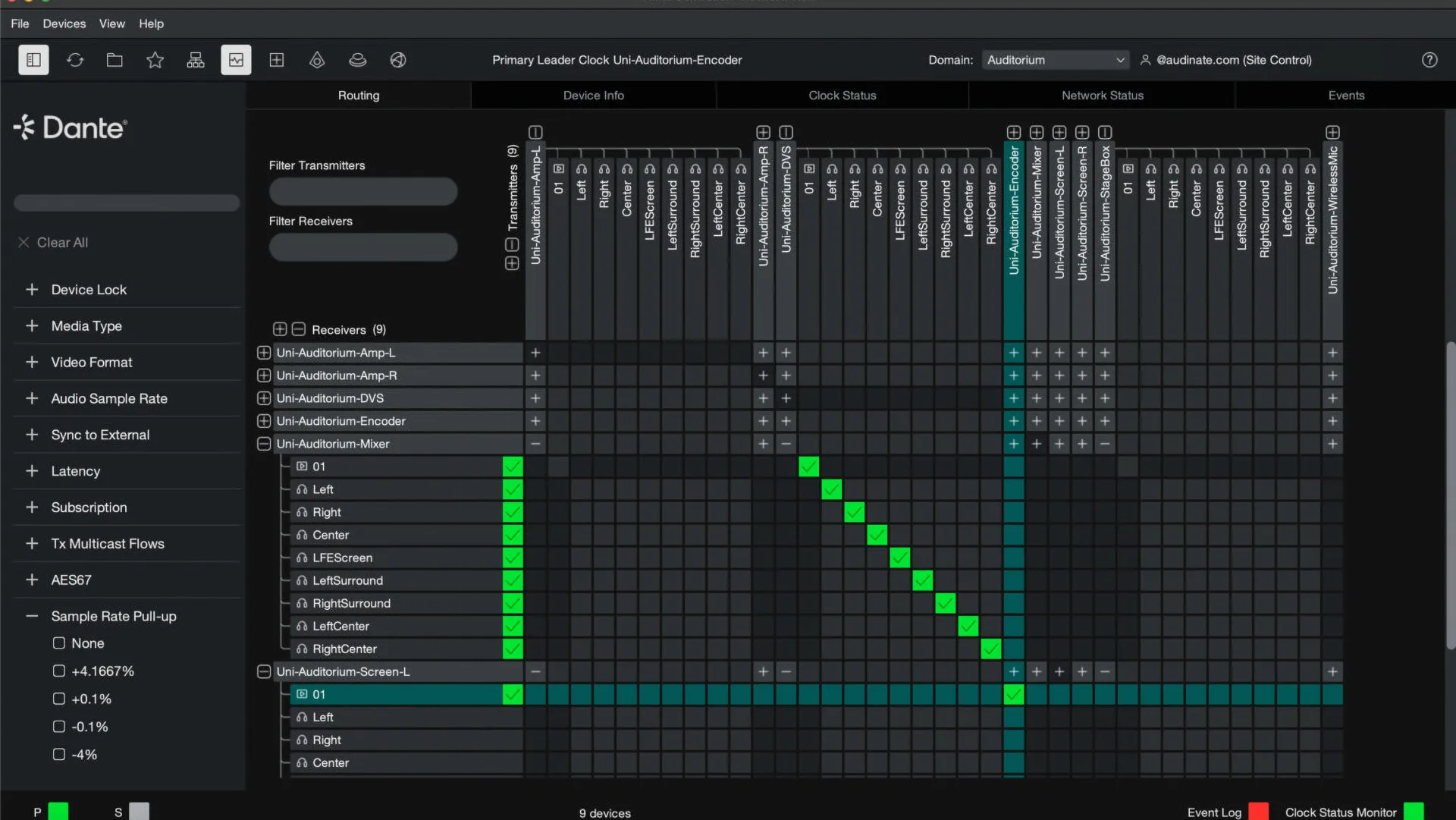
Dante systems optimize device management and connectivity. Image: nguyenthiet.com
Core Components of a Dante System
To build a professional Dante audio network, several essential components are required:
1. Dante-enabled Endpoints
These are hardware units with integrated Dante processing chips, such as digital mixers, DSPs (like the BSS Soundweb OMNI series), amplifiers (like the Crown DCi-DA series), or stageboxes. New products like the Soundweb OMNI even support up to 512x512 Dante channels, enabling the management of massive-scale projects.
2. Management Software
Dante Controller: A free tool used for signal routing and configuration. It automatically discovers devices on the network, making setup incredibly straightforward.
Dante Virtual Soundcard (DVS): This software turns your computer into a Dante device, allowing you to record or play audio directly from professional DAWs over the LAN.
3. Network Infrastructure (Network Switches)
Dante systems require Gigabit switches to ensure adequate bandwidth. For mission-critical systems, we typically deploy a redundant (Secondary) network to ensure audio remains uninterrupted if a cable fails on the primary network.
Dante in the HARMAN Ecosystem: BSS and Crown
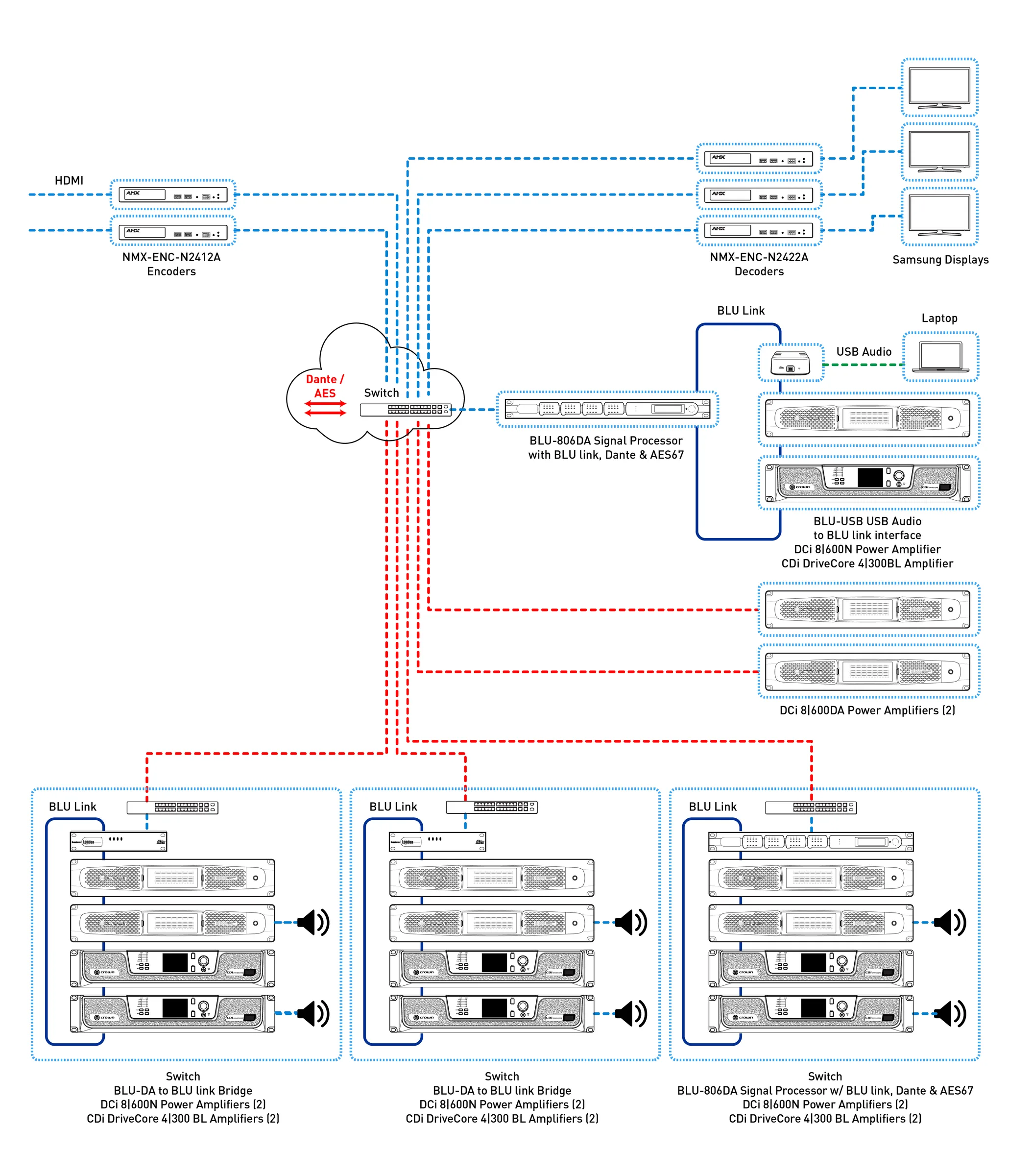
In high-end systems integration, combining BSS Soundweb processors with Crown amplifiers via Dante is a standard solution. These devices now support Dante 4.0, which is fully compatible with Dante Domain Manager (DDM).
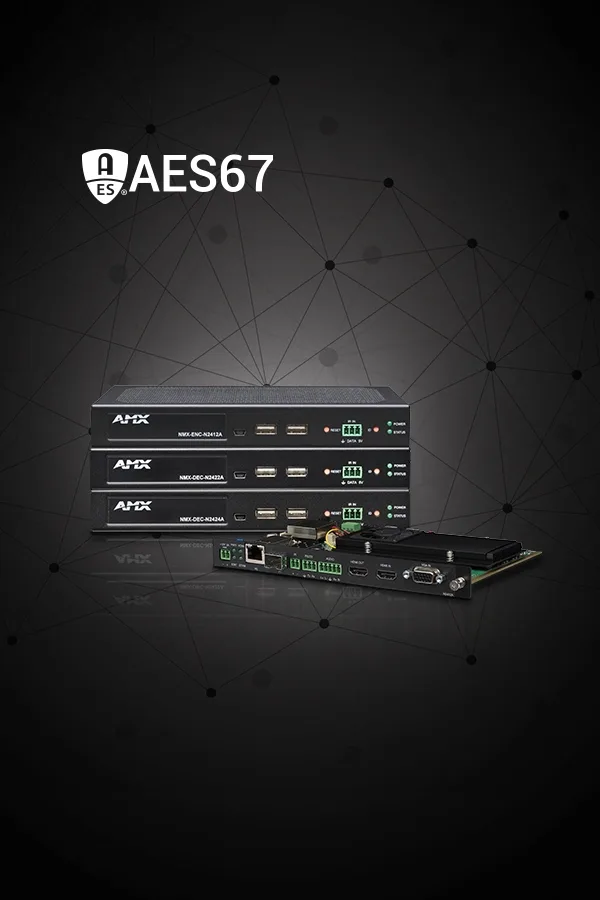
DDM is a significant leap for IT engineers, providing user-based security, device status monitoring via SNMP, and supporting audio routing across different subnets in large facilities. Additionally, AES67 support allows BSS processors to communicate seamlessly with other AoIP systems, including AMX video decoders.
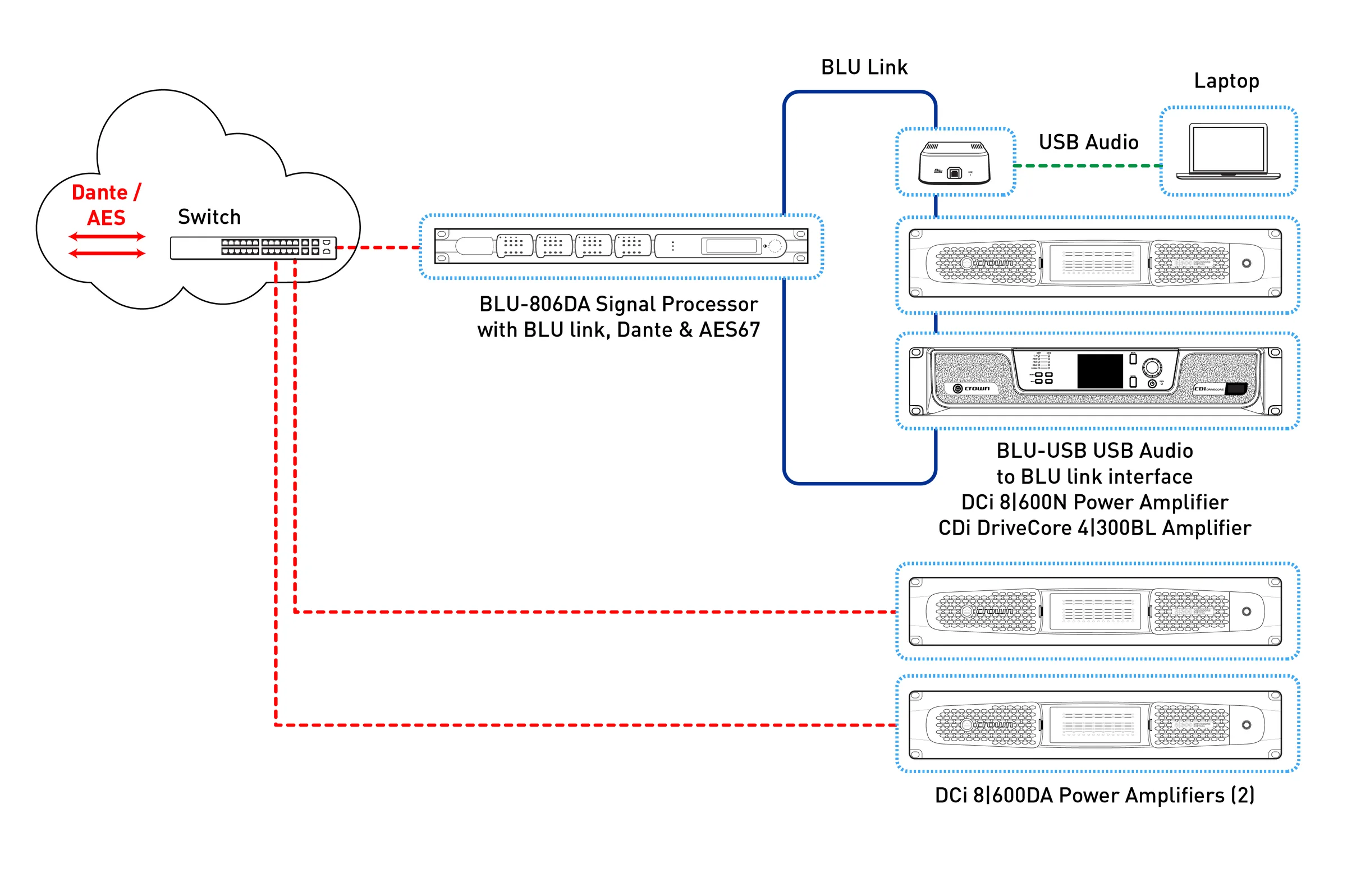
Dante application within the HARMAN equipment ecosystem. Image: bssaudio.com
Practical Tips for Implementation
Based on my field experience, here are a few key points for a stable Dante deployment:
Clear VLAN Planning: It is advisable to segregate Dante traffic from Office/Internet data if using shared switch infrastructure to avoid bandwidth contention.
Clock Management: Always designate a "Preferred Master" device to sync the network timing, preventing clicks and pops caused by clock drift.
Prioritize Switch Quality: Use switches that support QoS (Quality of Service) to prioritize audio packets.
Dante is not just a trend; it is a genuine revolution that frees audio engineers from the physical constraints of analog. Mastering this technology is the key to designing modern, flexible, and reliable AV systems.
Sources: BSS Networked Audio Systems, Nguyễn Thiết Blog
Ảnh: bssaudio.com, nguyenthiet.com
Ảnh: bssaudio.com, nguyenthiet.com
Ảnh: bssaudio.com, nguyenthiet.com
